The Search-to-Revenue Gap: Why AI Discovery Makes It Worse

The Search-to-Revenue gap occurs when travelers arrive ready to book but encounter friction before purchase.
In Part 1, I showed you where the customer journey breaks.
Here, I explain why AI makes that problem significantly more expensive to ignore.
The new pressure point for travel and hospitality brands
If a traveler arrives on your platform ready to book but leaves without a confirmation, does it matter if an AI recommended you?
Travel companies are racing to secure visibility in AI-searches, terrified of a future where a traveler asks for a hotel or a flight and only the competitor surfaces.
But this focus is on the wrong problem.
Discovery works. Conversion doesn’t.
Travel planning is already the world’s most successful search-driven behavior.
Every day, millions of transaction-ready travelers use Google to research routes, destinations, accommodations, and a host of other services. For most established travel platforms, search traffic is flowing.
The true constraint is what happens the moment that traffic arrives on the travel platform. It’s a recurring pattern: the traveler is ready to act, but they are met with brand narratives, forced app downloads, or navigation mazes when they simply want to check availability.
At that exact point of friction, revenue begins to leak. The booking is delayed or, more likely, lost to the competitor who made the "First Meaningful Action" easier to find.
In travel tech, discovery is not the problem. The Search-to-Revenue gap is.
The cause of the Search-to-Revenue gap
This gap happens because no one is asking the question that actually determines revenue: Where does the customer journey break between search and purchase?
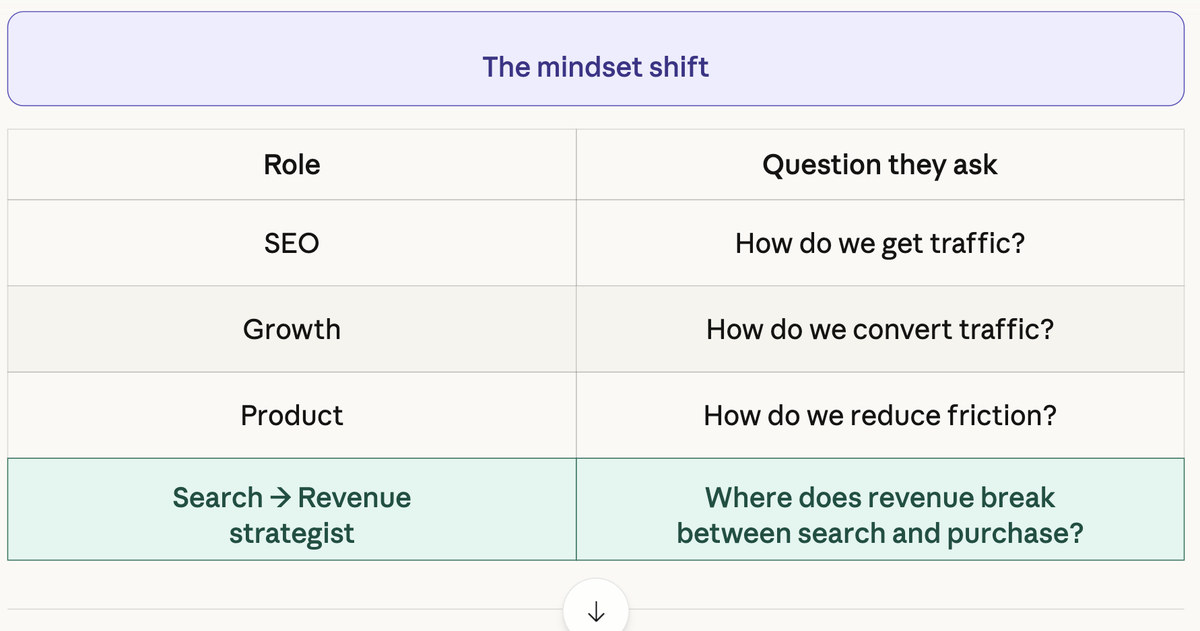
Inside many travel organizations, functions are siloed:
SEO teams focus on driving traffic (Discovery).
Product teams focus on long-term feature sets (Experience).
Growth teams focus on optimizing page elements (Conversion).
The result is a platform that ranks for everything but owns nothing.
Because these functions operate independently, no one is focused on the connective tissue: Did the traveler arrive at the exact experience they expected based on what they intended to do?
The platform may succeed at attracting visitors while failing at the only moment that matters: the transition from "searching" to "buying."
AI discovery accelerates the revenue leak
A traveler asking an AI assistant for a specific solution is already closer to making a decision than someone casually browsing a search results page.
If the travel platform cannot respond to the traffic that Google sends in that moment with clarity and immediacy, AI traffic will simply mean more people hitting your friction points.
This means if you’re investing in AI visibility but those visitors don't convert, your customer acquisition cost (CAC) doubles or triples—at an accelerated rate.
Stop the leak before you try to fill the bucket.